
Research Article: Journal of Drug and Alcohol Research (2026) Volume 15, Issue 1
Anxiety as a Mediator between Caffeine Dependence and Simple Reaction Time in College Sport Students
Amarpreet Singh1, Ajitpal Singh1, Shubhdip Kaur2, Jasmeen Kaur2, Saurabh Kant2*, Sukriti2, Kulbeer Singh3, Jagmeet Singh4, Kuldeep Singh5 and Prabhleen Kaur62Department of Psychology, Central University of Punjab, Bathinda, India
3Department of Physical Education, Government Rajindra College, Bathinda, India
4Department of English, Government Rajindra College, Bathinda, India
5Department of Physical Education and Sports, Swami Vivekanand Institute of Engineering and Technology, Jhansla, India
6Program Director, PLASP Child Care Services, Canada
Saurabh Kant, Department of Psychology, Central University of Punjab, Bathinda, India, Email: saurabh398kant@gmail.com
Received: 17-Mar-2025, Manuscript No. JDAR-25-162618 ; Editor assigned: 19-Mar-2025, Pre QC No. JDAR-25-162618 (PQ); Reviewed: 02-Apr-2025, QC No. JDAR-25-162618 ; Revised: 15-Jan-2026, Manuscript No. JDAR-25-162618 (R); Published: 22-Jan-2026, DOI: 10.4303/JDAR/236488
Abstract
Caffeine dependence among youngsters is becoming highly prevalent, especially among college sport students who rely heavily upon caffeine containing substances to manage rigorous physical training and academic responsibilities. The present study aimed to investigate the mediating role of anxiety between caffeine dependence and simple reaction time in college sports students. A correlational design with mediational analysis was employed to test the hypotheses. Sample consisted of 300 university sport students (158 males, 142 females) aged 18-25 years from private universities. Caffeine use disorder questionnaire, Hamilton anxiety scale and Stroop test were employed to study caffeine dependence, anxiety levels and reaction time respectively. Results revealed significant positive correlations among all variables. Reaction time (r=.43, p<.01) and anxiety (r=.47, p<.01) were positively correlated with caffeine dependence; anxiety was correlated with a shorter reaction time (r=.54, p<.01). Anxiety was found to have a substantial indirect influence (β=.20, p=.001, 95% CI (1.15, 2.13)) in mediating the link between coffee dependence and reaction time. Both direct (β=.23, p=.004) and total effects (β=.43, p=.021) continued to be significant, indicating that caffeine dependence influences cognitive function in numerous ways. These results suggest that caffeine addiction in college athletes leads to increased anxiety, which in turn affects cognitive function and reaction time. The findings underscore the necessity of caffeine consumption education and anxiety management treatments to maximize academic and athletic performance, with practical implications for university wellness programs and sports departments.
Keywords
Introduction
Caffeine is the most widely consumed psychoactive stimulant worldwide, and its popularity among young adults continues to grow, particularly within athletic and sportrelated contexts. College sport students often rely heavily on caffeine-containing substances to manage demanding training schedules, strenuous academic responsibilities, early morning practices, and competitive pressure [1].
Caffeine is readily available in diverse forms including coffee, tea, soft drinks, energy drinks, and pre-workout mixes which further facilitates high consumption levels. Although caffeine’s stimulatory properties are welldocumented and widely accepted within the sports community, concerns have increasingly emerged about the potential for excessive use and the development of caffeine dependence. Caffeine dependence is characterized by tolerance, withdrawal symptoms, repeated unsuccessful attempts to reduce intake, and continued use despite negative physiological or psychological consequences [2]. As patterns of habitual and escalating consumption become more common among student athletes, evaluating how dependence influences psychological and cognitive functioning becomes a matter of growing importance.
Caffeine is traditionally recognized for its enhancing effects on alertness, vigilance, and psychomotor speed through its antagonistic action on adenosine receptors in the central nervous system [3]. These mechanisms suggest potential benefits for cognitive performance, particularly in tasks requiring sustained attention or rapid response.
Simple reaction time defined as the interval between a single stimulus and the initiation of a response is an essential indicator of psychomotor speed and is foundational to many athletic skills. In sports such as sprinting, badminton, basketball, soccer, and tennis, milliseconds can determine success or failure during critical moments. Consequently, reaction time is not merely a laboratory-based cognitive variable but a practical performance indicator for trained athletes.
Although caffeine can enhance reaction speed at moderate doses, the relationship is not strictly linear; higher doses or chronic patterns of excessive intake may lead to diminishing returns or even impairments. Tolerance, dependence, and negative psychological effects may counteract the expected cognitive benefits. Individuals with caffeine dependence often experience withdrawal symptoms including fatigue, decreased alertness, irritability, and impaired concentration when they attempt to reduce intake or when caffeine is unavailable [4]. These withdrawal symptoms may slow reaction time, although the relationship is likely more complex and influenced by psychological states, especially anxiety.
Anxiety is one of the most consistently reported psychological outcomes of both acute and chronic caffeine use. Caffeine-induced anxiety is reported even at moderate doses in sensitive individuals and becomes more pronounced at higher doses or in users who exhibit dependence [5]. Symptoms of caffeine-related anxiety include nervousness, restlessness, increased heart rate, difficulty concentrating, and heightened physiological arousal.
College athletes already experience significant academic stress, intense competition-related anxiety, and pressure to maintain consistent performance. When combined with heavy caffeine intake, these underlying stressors can interact synergistically, resulting in elevated anxiety that surpasses normal competitive arousal. Such elevated anxiety may influence cognitive processing in detrimental ways.
Theoretical models such as Attentional Control Theory propose that anxiety disrupts processing efficiency by shifting attentional resources toward threat-related stimuli and irrelevant cognitive activity, thereby slowing response execution and impairing performance in simple reaction tasks [6]. Anxiety may interfere with perceptual speed, reduce working memory capacity, and increase cognitive interference, all of which can lengthen reaction time. For athletes, heightened anxiety can delay motor initiation, impair sensorimotor coordination, and undermine situational responsiveness factors crucial for optimal athletic performance. These effects suggest that anxiety may serve as a psychological mediator linking caffeine dependence to reaction time impairments.
Despite the theoretical plausibility of this mediation, existing empirical investigations seldom test the full pathway among caffeine dependence, anxiety, and reaction time. Prior research has largely addressed these variables in isolation. Studies on caffeine consumption in athletes primarily emphasize its physiological effects such as improved endurance, reduced perceived exertion, or enhanced muscular activation while psychological outcomes remain underrepresented [7]. Meanwhile, research on caffeineinduced anxiety is robust within general populations but less explored within competitive athletic settings, where unique lifestyle patterns and performance expectations may alter the nature of the relationship. Similarly, the literature on reaction time in athletes typically focuses on situational anxiety, fatigue, sleep deprivation, or training load rather than caffeine dependence as an antecedent.
College sport students represent a particularly relevant population in which to explore these relationships. Their environments include early-morning training sessions, late-night study routines, competitive pressure, and irregular sleep schedules, all of which promote increased caffeine use. Energy drinks and pre-workout supplements often containing high levels of caffeine are marketed aggressively to athletes and are frequently consumed to overcome fatigue or enhance performance. However, these consumption patterns may mask early signs of dependence and normalize escalating caffeine intake. Athletes may misinterpret caffeine-induced anxiety as typical performance anxiety, thereby failing to recognize the psychological consequences of dependence.
Furthermore, reaction time is a sensitive cognitive indicator that can capture subtle impairments linked to anxiety or stimulant overuse. Research has found that heightened anxiety slows response initiation by increasing physiological arousal beyond optimal levels, narrowing attentional focus, and reducing processing efficiency [8]. Within sports contexts, anxiety may interfere with anticipatory skills, perceptual decision-making, and coordination functions directly linked to simple reaction time.
Given these relationships, examining anxiety as a mediator between caffeine dependence and simple reaction time is theoretically meaningful and practically important. If caffeine dependence leads to elevated anxiety, and anxiety subsequently slows reaction time, this would explain why athletes with high levels of dependence may not consistently benefit from caffeine’s stimulant properties. Instead, anxiety may counteract or overshadow the ergogenic effects, resulting in impaired cognitive performance despite high caffeine use. Understanding this mediation can inform preventive strategies in sports training, caffeine consumption guidelines, and mental health intervention programs.
The psychobiological perspective of performance enhancement suggests that cognitive outcomes are influenced by the dynamic interaction between stimulant effects and emotional states [9]. Within this model, emotional factors such as anxiety may play a more significant role in determining stimulant-related performance outcomes than traditionally acknowledged. This perspective supports the examination of caffeine dependence not merely as a behavioral pattern but as a psychological condition with emotional and cognitive implications. Exploring the mediating role of anxiety contributes to this broader conceptualization and aligns with contemporary views on substance use that integrate behavioral, cognitive, and affective components.
Despite its importance, the mediating role of anxiety in the caffeine reaction time relationship remains empirically untested in athletic populations, representing a critical gap in the literature. Filling this gap may help clarify inconsistent findings in caffeine research, where some studies report improved reaction time and others report null or negative effects. These discrepancies may be attributable to unmeasured psychological variables such as anxiety, particularly among individuals with dependence. Identifying anxiety as a mediator would highlight the need for integrated performance strategies that address both substance use patterns and psychological well-being.
In conclusion, caffeine dependence, anxiety, and reaction time are intimately connected through physiological, psychological, and cognitive pathways. Existing evidence suggests that college sport students are at heightened risk for caffeine dependence and elevated anxiety, and that anxiety can impair reaction time. However, the combined influence of these variables has received little empirical attention. The present study seeks to address this gap by examining anxiety as a mediator between caffeine dependence and simple reaction time in college sport students. This investigation has the potential to advance theoretical understanding of stimulant use and psychological functioning in athletes while offering practical implications for performance optimization and mental health support within collegiate sports environments.
Research objectives
• To examine the relationship between caffeine dependence and anxiety among college sport students.
• To investigate the relationship between anxiety and simple reaction time.
• To assess the direct relationship between caffeine dependence and simple reaction time.
• To test whether anxiety mediates the relationship between caffeine dependence and simple reaction time.
Hypotheses
• H1: Caffeine dependence will be positively associated with anxiety levels among college sport students. Higher caffeine dependence will predict higher anxiety.
• H2: Anxiety will be positively associated with simple reaction time. Higher anxiety levels will predict slower (longer) simple reaction time.
• H3: Caffeine dependence will be positively associated with simple reaction time. Higher caffeine dependence will predict slower (longer) reaction time.
• H4 (Mediation hypothesis): Anxiety will mediate the relationship between caffeine dependence and simple reaction time. Caffeine dependence will indirectly slow reaction time through its effect on increasing anxiety.
Materials and Methods
Research design
This study employed a correlational research design with mediation analysis to examine the relationships between caffeine dependence, anxiety, and simple reaction time among college sport students. A quantitative approach was adopted to measure the variables using standardized instruments and objective reaction time tests. The design allows for testing both direct and indirect (mediated) effects, in line with the study’s hypotheses.
Participants
The study consisted of 300 (158 males and 142 females) university sports students within the age range of 18- 25 years from five private universities of Punjab. All the participants were enrolled in some kind of sport and spent at least 2 hours every day in training and physical activity.
Tools used
Caffeine use disorder questionnaire: Caffeine use disorder questionnaire was used to assess caffeine addictive patterns of young college sports students. It is a 10-item measure assessing addictive patterns of caffeine based on DSM- 5 criteria. Items are rated on a four-point likert scale, and higher scores indicate stronger coffee addiction tendencies. The scale has demonstrated good reliability and validity [10].
Hamilton Anxiety Rating Scale (HAM-A): Hamilton anxiety rating scale was used to measure the anxiety of the college sports students. It consists of 14 items covering psychic and somatic anxiety, rated on a 5-point scale from 0 (none) to 4 (severe). Higher total scores indicate greater anxiety severity. The administration of this test takes 10-15 minutes [11].
Stroop test: Stroop test available on Psytoolkit was used to assess the reaction time of the participants. The Stroop test measures cognitive interference via Reaction Time (RT) to name ink colors of congruent/incongruent words (e.g., “RED” in blue), with 50-150 ms longer RT in incongruent trials indicating executive control deficits. Three conditions (word reading, color naming, color-word) are completed, recording total RT per condition.
Procedure
Data collection was carried out in a quiet laboratory environment. Participants were invited individually and seated comfortably. Prior to administration of the measures, rapport was established and informed consent was obtained. Standardized instructions were provided to ensure uniform understanding.
Participants first completed a questionnaire booklet that included demographic information, the Hamilton Anxiety Rating Scale (HAM-A), and the Caffeine addiction scale. After completing the questionnaires, the Stroop test was administered on the researcher’s laptop under controlled conditions. All measures were completed in a single session lasting approximately 30-45 minutes per participant.
Once data collection was complete, the collected data was analyzed using SPSS and Jamovi.
Results
Descriptive analyses showed that participants had moderate levels of caffeine dependence (M=25.31, SD=6.14) and anxiety (M=25.98, SD=5.52). Mean reaction time on the Stroop test was 659.75 ms (SD=47.56). Medians were comparable to the means for all variables, and standard errors were low, indicating stable estimates (Table 1). Normality diagnostics indicated that all variables met acceptable distribution ranges. Shapiro–Wilk tests were non-significant for caffeine dependence, anxiety, and reaction time (p>.05), and skewness and kurtosis values were within ± 1,suggesting no major deviations from normality (Table 2). Pearson correlations indicated significant positive relationships among all variables. Caffeine dependence correlated positively with anxiety (r=.47, p<.01) and reaction time (r=.43, p<.01). Anxiety also showed a positive correlation with reaction time (r=.54, p<.01), suggesting that higher caffeine dependence and anxiety were associated with slower reaction times (Table 3).
| Statistic | Caffeine dependence | Anxiety | Reaction time (ms) |
| Mean | 25.31 | 25.98 | 659.75 |
| Median | 25 | 26 | 654.5 |
| SD | 6.14 | 5.52 | 47.56 |
| Variance | 37.65 | 30.49 | 2261.97 |
| Standard Error (SE) | 0.354 | 0.319 | 2.746 |
Table 1: Descriptive statistics
| Variables | Shapiro-Wilk | Skewness | Kurtosis | Reaction time (ms) |
| Statistic | Sig. | |||
| Caffeine dependence | 0.993 | 0.16 | 0.12 | -0.28 |
| Anxiety | 0.995 | 0.37 | -0.09 | 0.11 |
| Reaction time | 0.994 | 0.316 | 0.15 | -0.19 |
Table 2: Normality
| Variable | 1 | 2 | 3 |
| Caffeine dependence | |||
| Anxiety | .47** | ---- | |
| Reaction time | .43** | .54** | ----- |
Table 3: Correlation among variables
The mediation analysis revealed a significant indirect effect of caffeine dependence on reaction time through anxiety (β=.20, z=6.47, p=.001). The bootstrapped 95% confidence interval did not include zero (1.15 to 2.13), indicating a reliable mediating role of anxiety (Table 4).
| 95% C.I. | ||||||||
| Type | Effect | Estimate | SE | Lower | Upper | β | z | p |
| Indirect | Caffeine ⇒ Anxiety ⇒ Reaction time | 1.5981 | 0.2471 | 1.1546 | 2.1277 | 0.2 | 6.47 | 0.001 |
Table 4: Indirect effect estimates for the mediation model
Path analysis showed that caffeine dependence significantly predicted anxiety (path a: β=.47, z=8.53, p=.018). In turn, anxiety significantly predicted reaction time while controlling for caffeine (path b: β=.42, z=9.05, p=.003). Both paths were statistically meaningful, supporting the mechanism underlying the indirect effect (Table 5). The analysis showed a significant direct effect of caffeine dependence on reaction time after accounting for anxiety (c′: β=.23, z=4.75, p=.004). The total effect of caffeine on reaction time was also significant (c: β=.43, z=8.25, p= .021). Both confidence intervals excluded zero, indicating that caffeine dependence is a meaningful predictor of reaction time both before and after including the mediator (Table 6).
| 95% C.I. | ||||||||
| Component | Effect | Estimate | SE | Lower | Upper | β | z | p |
| Caffeine ⇒ Anxiety | Path a | 0.3995 | 0.0468 | 0.307 | 0.492 | 0.47 | 8.53 | 0.018 |
| Anxiety ⇒ Reaction time | Path b (Controlling X) | 4.0006 | 0.442 | 3.133 | 4.868 | 0.42 | 9.05 | 0.003 |
Table 5: Mediation model path coefficients
| 95% C.I. | ||||||||
| Type | Effect | Estimate | SE | Lower | Upper | β | z | p |
| Direct | Caffeine ⇒ Reaction time (c’) | 1.902 | 0.4 | 1.118 | 2.686 | 0.23 | 4.75 | 0.004 |
| Total | Caffeine ⇒ Reaction time (c) | 3.5 | 0.42 | 2.67 | 4.324 | 0.43 | 8.25 | 0.021 |
Table 6: Direct and total effect analysis
Mediation model showing that caffeine dependence predicts slower reaction time both directly and indirectly through anxiety. Path coefficients indicate significant effects for path a (β=.47, p<.001), path b (β=.42, p=.003), the indirect effect (β=.20, p<.001), and the direct effect (β= .23, p=.004) (Figure 1).
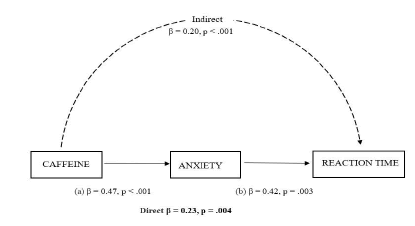
Figure 1: Mediation model
Discussion
The present study examined the relationships among caffeine dependence, anxiety, and cognitive performance (operationalized as reaction time on the Stroop task in a sample of college sport students. Four hypotheses were tested, and all received clear empirical support.
Consistent with H1, caffeine dependence was positively and substantially associated with anxiety levels (r=.47, p <.01; path a β=.47, p=.018). This finding aligns with a large body of evidence demonstrating that chronic heavy caffeine intake is linked to heightened anxiety symptoms in young adults [12,13]. College athletes and sport students represent a population particularly vulnerable to excessive caffeine consumption through energy drinks, pre-workout supplements, and coffee, often used to cope with academic and training demands [14]. The observed moderate mean caffeine dependence score (M=25.31 on the caffeine dependence questionnaire) suggests that many participants had already crossed into clinically meaningful dependence, which likely contributes to sustained activation of the hypothalamic-pituitary-adrenal axis and elevated trait anxiety [15,16].
H2 predicted that higher anxiety would be associated with slower reaction time, and this hypothesis was strongly supported (r=.54, p<.01; path b β=.42, p=.003). Anxiety is well-established as a factor that impairs processing efficiency and attentional control, particularly on tasks requiring inhibition such as the Stroop test [6,17]. According to attentional control theory, anxiety consumes working memory resources and strengthens stimulus-driven (bottom-up) attentional systems at the expense of goaldirected (top-down) control, resulting in longer response latencies even on congruent trials [18]. The present mean reaction time of approximately 660 ms with low variability (SD=47.56 ms) is consistent with previous Stroop data in young adults under moderate anxiety conditions [19].
H3 proposed a direct positive association between caffeine dependence and slower reaction time, which was also confirmed (total effect c β=.43, p=.021). Acute high doses of caffeine typically shorten reaction time via adenosine receptor antagonism [20]; however, in dependent individuals who consume caffeine chronically, tolerance develops, and withdrawal symptoms (even mild subclinical withdrawal between doses) can produce cognitive slowing [21,22]. The present cross-sectional design captured habitual caffeine users, many of whom likely tested in varying stages of withdrawal or tolerance, explaining the net slowing effect.
Most importantly, H4 posited that anxiety would mediate the caffeine dependence → reaction time relationship. Mediation analysis using 5,000 bootstrap samples confirmed a significant indirect effect (β=.20, 95% CI (1.15, 2.13), p=.001). Anxiety partially mediated the association, as evidenced by a reduction in the direct path from β=.43 (total effect) to β=.23 (direct effect c′) when anxiety was included in the model, yet the direct effect remained significant (p=.004). This pattern indicates that at least two mechanisms are operating:
• Anxiety as a psychological mediator (likely through chronic arousal and worry).
• Direct neurobiological effects of chronic caffeine exposure and/or intermittent withdrawal on prefrontal and motor systems supporting response inhibition [23,21].
Partial mediation is common in psychopharmacological research when both psychological and physiological pathways coexist [21].
These results extend previous work by demonstrating the mediating role of anxiety in a specific high-caffeine-risk population college sport students using a continuous measure of dependence rather than arbitrary cutoff scores. The Stroop task provided an ecologically valid index of executive attention and inhibitory control, functions critical for athletic performance and academic success.
Limitations should be acknowledged. The cross-sectional design precludes causal inference; experimental or longitudinal studies manipulating caffeine intake and withdrawal are needed. Self-reported caffeine dependence may be influenced by social desirability, although the questionnaire used has excellent psychometric properties [22]. Finally, state anxiety during testing was not measured; future studies should include both trait and state measures to disentangle their contributions.
Conclusion
In conclusion, caffeine dependence in college sport students is associated with heightened anxiety and impaired cognitive efficiency, with anxiety partially explaining slower inhibitory performance. These findings have practical implications for athletic departments and university wellness programs: routine screening for caffeine dependence and psychoeducation about withdrawal-related anxiety and cognitive costs may help mitigate unnecessary performance impairment in this population.
References
- J. Grgic, C. Pickering, D. J. Bishop, B. J. Schoenfeld, P. Mikulic, et al. CYP1A2 genotype and acute ergogenic effects of caffeine intake on exercise performance: A systematic review, Eur J Sport Sci, 20(2020):1208–1221.
- S. E. Meredith, L. M. Juliano, J. R. Hughes, R. R. Griffiths, Caffeine use disorder: A comprehensive review and research agenda, J Caffeine Res, 3(2013):114–130.
[Crossref] [Google Scholar] [PubMed]
- S. J. L. Einöther, T. Giesbrecht, Caffeine as an attention enhancer: Reviewing existing assumptions, Psychopharmacology, 225(2013):251–274.
[Crossref] [Google Scholar] [PubMed]
- L. M. Juliano, R. R. Griffiths, A critical review of caffeine withdrawal: Empirical validation of symptoms and signs, incidence, severity, and associated features, Psychopharmacology, 235(2018):1629–1659.
[Crossref] [Google Scholar] [PubMed]
- E. Childs, H. de Wit, Subjective, behavioral, and physiological effects of acute caffeine in light, nondependent caffeine users, Psychopharmacology, 185(2006):514–523.
[Crossref] [Google Scholar] [PubMed]
- M. W. Eysenck, N. Derakshan, R. Santos, M. G. Calvo, Anxiety and cognitive performance: Attentional control theory, Emotion, 7(2007):336–353.
- J. Mielgo-Ayuso, D. Marques-Jiménez, I. Refoyo, J. Del Coso, P. León-Guereño, et al. Effect of caffeine supplementation on sports performance based on differences between sexes: A systematic review, Nutrients, 11(2019):2313.
- A. Nieuwenhuys, R. R. D. Oudejans, Anxiety and perceptual–motor performance: Toward an integrated model of concepts, mechanisms, and processes, Psychol Res, 76(2012):747–759.
[Crossref] [Google Scholar] [PubMed]
- S. M. Marcora, Counterpoint: Afferent feedback from fatigued locomotor muscles is not an important determinant of endurance exercise performance, J Appl Physiol, 108(2010):454–456.
[Crossref] [Google Scholar] [PubMed]
- C. Ágoston, R. Urbán, M. J. Richman, Z. Demetrovics, Caffeine use disorder: An item-response theory analysis of proposed DSM-5 criteria, Addict Behav, 81(2018):109–116.
[Crossref] [Google Scholar] [PubMed]
- M. A. X. Hamilton, The assessment of anxiety states by rating, Br J Med Psychol, (1959).
- D. R. Lara, Caffeine, mental health, and psychiatric disorders, J Alzheimer’s Dis, 20(2010):S239–S248.
[Crossref] [Google Scholar] [PubMed]
- G. Richards, A. P. Smith, Caffeine consumption and self-assessed stress, anxiety, and depression in secondary school children, J Psychopharmacol, 29(2015):1236–1247.
[Crossref] [Google Scholar] [PubMed]
- M. L. Pettit, K. A. DeBarr, Perceived stress, energy drink consumption, and academic performance among college students, J Am Coll Health, 59(2011):335–341.
[Crossref] [Google Scholar] [PubMed]
- W. R. Lovallo, T. L. Whitsett, M. F. al’Absi, B. H. Sung, A. S. Vincent, et al. Caffeine stimulation of cortisol secretion across the waking hours in relation to caffeine intake levels, Psychosom Med, 67(2005):734–739.
[Crossref] [Google Scholar] [PubMed]
- A. P. Smith, Effects of caffeine on human behavior, Food Chem Toxicol, 40(2002):1243–1255.
- N. Derakshan, M. W. Eysenck, Anxiety, processing efficiency, and cognitive performance: New developments from attentional control theory, Eur Psychol, 14(2009):168–176.
- M. W. Eysenck, N. Derakshan, New perspectives in attentional control theory, Pers Individ Differ, 50(2011):955–960.
- C. D. Spielberger, P. R. Vagg. Test anxiety: A transactional process model, Taylor & Francis, (1995).
- P. J. Rogers, J. E. Smith, S. V. Heatherley, C. W. Pleydell-Pearce, Time for tea: Mood, blood pressure and cognitive performance effects of caffeine and theanine administered alone and together, Psychopharmacology, 195(2005):569–577.
[Crossref] [Google Scholar] [PubMed]
- P. J. Rogers, S. V. Heatherley, E. L. Mullings, J. E. Smith, Faster but not smarter: Effects of caffeine and caffeine withdrawal on alertness and performance, Psychopharmacology, 226(2013):229–240.
- C. W. Striley, R. R. Griffiths, L. B. Cottler, Evaluating dependence criteria for caffeine, J Caffeine Res, 1(2011):219–225.
[Crossref] [Google Scholar] [PubMed]
- S. V. Heatherley, R. C. Hayward, H. E. Seers, P. J. Rogers, Cognitive and psychomotor performance, mood, and pressor effects of caffeine after 4, 6 and 8 h caffeine abstinence, Psychopharmacology, 178(2005):461–470.
Copyright: © 2026 Amarpreet Singh, et al. This is an open access article distributed under the terms of the Creative Commons Attribution License, which permits unrestricted use, distribution, and reproduction in any medium, provided the original work is properly cited.