
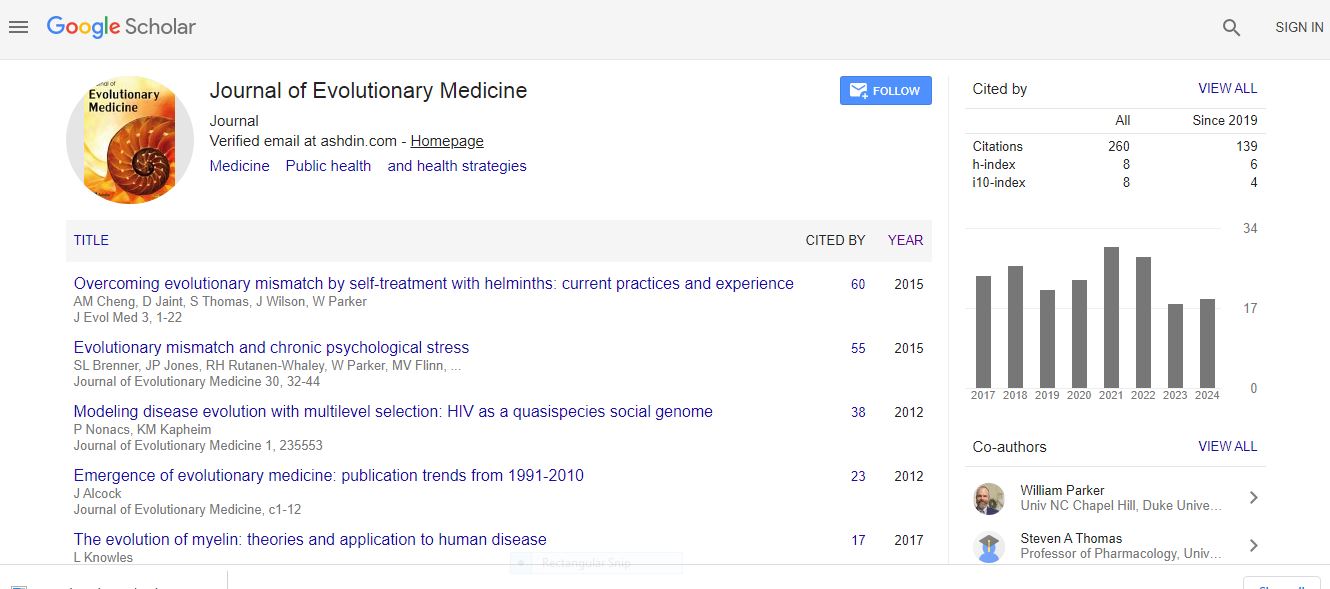
Commentary: Journal of Evolutionary Medicine (2025) Volume 13, Issue 1
The Role of Evolutionary Understanding in Shaping Modern Medicine
James Cooper*James Cooper, Department of Medical Science, University of Riverside, California, USA, Email: james.cooper@universityofriverside.edu
Received: 29-Jan-2025, Manuscript No. JEM-25-174490; Editor assigned: 31-Jan-2025, Pre QC No. JEM-25-174490 (PQ); Reviewed: 14-Feb-2025, QC No. JEM-25-174490; Revised: 20-Feb-2025, Manuscript No. JEM-25-174490 (R); Published: 28-Feb-2025, DOI: 10.4303/jem/150308
Abstract
Description
Medicine is a field that has always been in a state of flux, with advancements continually redefining how we treat illness and promote well-being. Yet, one of the most profound changes we may experience in the future is the integration of evolutionary theory into everyday medical practice. Over the last few decades, our understanding of human biology, genetics and disease has greatly expanded and increasingly, this knowledge is revealing just how much evolution has shaped the human body. Insights into how our ancestors adapted to their environment and how those adaptations manifest in our physiology and susceptibility to diseases, are now being recognized as invaluable tools for improving healthcare.
At the heart of this evolution in thought is the realization that much of human health cannot be fully understood without considering the evolutionary context in which our bodies have developed. For example, many chronic conditions that are prevalent today, such as heart disease, diabetes and certain types of cancer, can be better understood through the lens of evolutionary biology. These diseases, often seen as modern afflictions, may have roots in the distant past when survival required different physiological strategies. By examining how these conditions are influenced by our evolutionary history, healthcare providers may gain a clearer picture of how to prevent, treat or manage these diseases.
Take, for instance, the way human beings store fat. In early human history, the ability to store fat was critical for survival during times of food scarcity. Today, however, this same evolutionary trait is a contributing factor to the obesity epidemic, as our bodies retain fat in ways that were once essential but are now less necessary. By understanding how our genetic predispositions to store fat have evolved, medical professionals can develop more effective approaches to weight management that go beyond simple calorie counting. A more nuanced approach to these issues could take into account individual genetic variations and ancestral patterns that predispose certain populations to specific health concerns.
Evolutionary insights can also provide a deeper understanding of how diseases spread and why certain populations are more susceptible to specific conditions. Consider genetic diseases like sickle cell anaemia, which, although harmful, provides a survival advantage against malaria in regions where the disease is prevalent. By recognizing the relationship between our genes and the diseases we face, doctors can better diagnose and treat illnesses by considering both individual genetics and evolutionary factors. This also leads to a more personalized approach to medicine, where doctors can tailor treatment plans not only to the patient’s symptoms but to the genetic and evolutionary background that has shaped their body’s response to disease.
Moreover, evolutionary biology can offer new perspectives on human development and aging. The way our bodies age, the onset of age-related diseases and the limits of our longevity are all tied to evolutionary pressures. The application of evolutionary theory also leads to more informed public health strategies. By understanding the evolutionary history of diseases, we can predict potential outbreaks, better manage infectious diseases and respond more effectively to pandemics. Historical patterns of disease, from the Spanish flu to the more recent COVID-19 pandemic, have shown us that pathogens evolve rapidly in response to human behaviour and environmental changes. Public health policies that take into account this evolutionary dance between humans and microbes will be better equipped to prevent and manage future public health crises.
While integrating evolutionary principles into medical practice is still a relatively new concept, the growing body of research suggests that it could transform how we think about health and disease. One of the greatest advantages of adopting this approach is its ability to inform preventive medicine. By understanding how human evolution has shaped our bodies and predisposed us to certain conditions, medical professionals can design strategies to prevent illness before it even has a chance to take hold. These strategies could include changes in diet, lifestyle and exercise routines that account for our evolutionary needs, rather than simply responding to diseases once they occur.
Additionally, evolutionary insights could lead to a more comprehensive understanding of mental health. Mental health disorders, including depression and anxiety, often have a complex interplay of genetic, environmental and social factors. Through the lens of evolution, these conditions can be viewed as maladaptive responses to modern-day stressors that were once adaptive in the face of ancient environmental challenges. This understanding could inspire new approaches to mental health treatment that address both the symptoms and the underlying evolutionary causes.
In conclusion, the growing integration of evolutionary principles into medical practice offers a more holistic view of human health. It challenges the traditional approach of simply treating diseases based on symptoms and encourages a more personalized, preventative approach that considers the full spectrum of human history and biology. As research continues to uncover the ways in which evolution has shaped our bodies, we may find that the future of medicine lies not only in treating illness but in understanding the complex evolutionary forces that have made us who we are. This shift could lead to more effective treatments, improved public health strategies and a greater emphasis on prevention, ultimately helping people live healthier, longer lives.
Copyright: © 2025 James Cooper. This is an open-access article distributed under the terms of the Creative Commons Attribution License, which permits unrestricted use, distribution and reproduction in any medium, provided the original author and source are credited.