
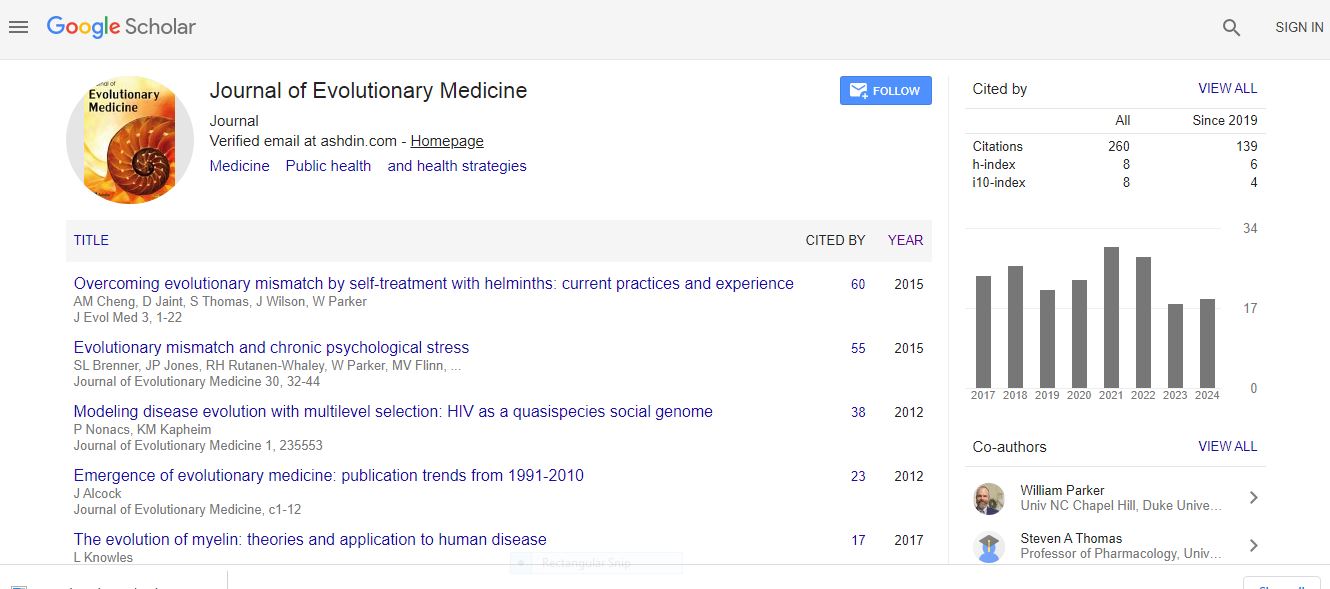
Commentary: Journal of Evolutionary Medicine (2025) Volume 13, Issue 1
The Evolutionary Foundations of Disease: What Biology Tells Us About Medicine
John Smith*John Smith, Department of Biology, Oxford University, Oxford, United Kingdom, Email: john.smith@oxford.edu
Received: 29-Jan-2025, Manuscript No. JEM-25-174488; Editor assigned: 31-Jan-2025, Pre QC No. JEM-25-174488 (PQ); Reviewed: 14-Feb-2025, QC No. JEM-25-174488; Revised: 20-Feb-2025, Manuscript No. JEM-25-174488 (R); Published: 28-Feb-2025, DOI: 10.4303/jem/150306
Description
Health is not merely the absence of illness; it is a state shaped by centuries of evolutionary adaptations. Our bodies are products of complex interactions between genetic evolution, environmental factors and social influences, all of which have intricately influenced our susceptibility to disease and our ability to maintain well-being. The field of health sciences draws upon these evolutionary developments to better understand how biological systems function and how we can enhance them to improve health outcomes. By examining how evolution has sculpted the human body, we can begin to see the deep connections between our biology and the medical practices that are so central to modern life.
As early humans learned to manipulate their environment, they also began to understand the importance of certain biological processes in maintaining health. The discovery of medicinal plants and the use of natural remedies can be traced back to our earliest ancestors. Over time, these practices evolved into more sophisticated forms of healing. Yet, many of the principles that underlie traditional medicine, from the balance of humors in ancient Greek theory to the practice of herbalism, are rooted in an understanding of how the body interacts with its environment.
Today, as we study the intersection of biology and medicine, we are confronted with the realization that many diseases and health conditions we face in modern society are tied to our evolutionary history. For instance, conditions like diabetes, cardiovascular disease and cancer are, in part, by- products of the mismatch between our ancient biology and the demands of contemporary life. Our bodies evolved to handle a much different environment one characterized by scarcity, physical labor and intermittent periods of food shortages compared to the abundant, sedentary lifestyle of modern society.
One area of particular interest is the concept of the “thrifty gene hypothesis,” which suggests that humans evolved to store fat efficiently during times of food scarcity. In times of abundance, however, this adaptation becomes maladaptive, leading to obesity and related diseases. Similarly, the rise of diseases like hypertension and type 2 diabetes can be understood as mismatches between the body’s evolved mechanisms for handling stress and the chronic stressors of modern life. These examples highlight how our bodies are not perfectly attuned to the modern environment, but instead are the result of long periods of evolutionary adaptation to the challenges faced by our ancestors.
Moreover, the role of infectious diseases in shaping human health cannot be overlooked. Throughout history, epidemics and pandemics have significantly impacted human populations, exerting strong evolutionary pressure on both pathogens and their hosts. For example, the emergence of antibiotic resistance is a direct consequence of the evolutionary arms race between humans and microbes. The use of antibiotics, though incredibly effective in treating bacterial infections, has inadvertently led to the selection of resistant strains of bacteria, making some infections harder to treat. This is a prime example of how evolutionary dynamics continue to shape the landscape of health and disease.
Another important aspect of understanding health through the lens of evolution is the role of genetics. Over time, humans have developed a variety of genetic traits that influence disease susceptibility and resilience. Some genetic variations provide protection against certain diseases, while others may predispose individuals to specific health conditions. For instance, sickle cell anemia, a genetic disorder that affects red blood cells, is much more common in regions where malaria is prevalent. This genetic trait, though detrimental in the homozygous state, confers a level of protection against malaria in the heterozygous state This interplay between genetics and disease demonstrates the complexities of evolutionary biology in the context of health.
As the medical field continues to advance, the insights gained from studying evolutionary biology are becoming increasingly important. Modern medicine is beginning to take into account the ways in which our evolutionary past shapes the way we respond to illness and treatment. For instance, personalized medicine, which tailor’s treatments to an individual’s genetic makeup, is an exciting development that is rooted in the understanding of human genetics and evolutionary biology. By acknowledging that no two people are genetically identical and that our evolutionary histories influence our biology in unique ways, healthcare can become more precise and effective.
In conclusion, the evolution of human health is a product of complex biological processes that have shaped our bodies and minds over millennia. By understanding the evolutionary origins of our health and well-being, we can gain deeper insights into the diseases and conditions that afflict us today. As the fields of biology and medicine continue to evolve, integrating these insights into healthcare practices holds immense potential for improving health outcomes worldwide. Recognizing the interplay between biology and medicine is essential for developing a holistic approach to health that addresses both the biological and environmental factors that influence our well-being. The future of medicine, informed by the lessons of evolutionary biology, promises a more integrated and informed approach to maintaining health and curing disease.
Copyright: © 2025 John Smith. This is an open-access article distributed under the terms of the Creative Commons Attribution License, which permits unrestricted use, distribution and reproduction in any medium, provided the original author and source are credited.